
Home / Blog / Moving into a Plano home: dryer inspection checklist
Moving Into a Plano Home: Dryer Inspection Checklist
A new home’s laundry area hides a few things that matter: the hookup, the outlet and the vent. Here is what to check before your first load.
Last reviewed October 1, 2026. Written and reviewed by the Plano Dryer Pros team. How we create content
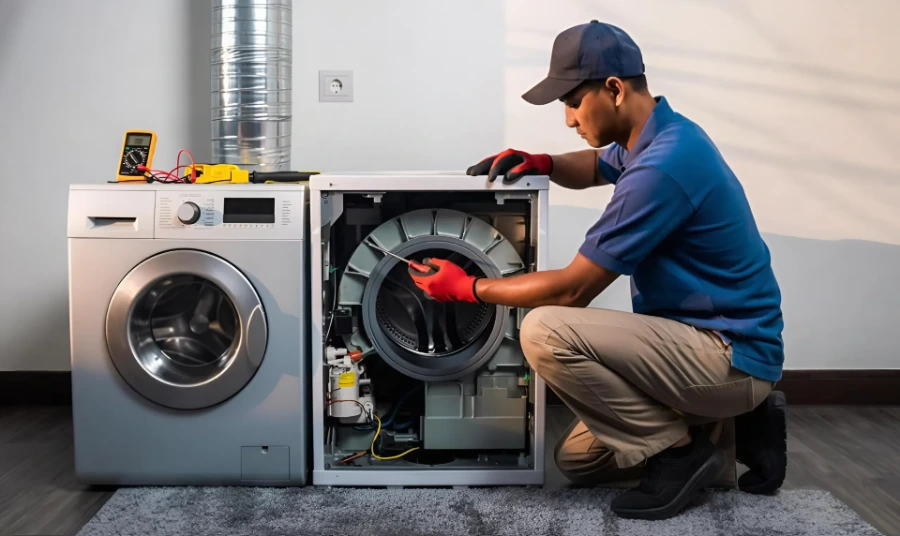
When you move into a Plano home, check what dryer hookup it has, whether the outlet or gas valve matches your dryer, how the vent runs and where it ends, and run a test cycle. Ask the seller about the vent’s last cleaning, and for the manual and model number of any dryer that stays.
Key takeaways
- Find out whether the home is set up for gas or electric, and whether the hookup matches your dryer.
- Check the outlet type, the gas valve and connector, and the cord for damage.
- Trace the vent run and the outside hood, and run the ten-minute airflow test.
- Ask for the last vent cleaning, and the manual and model number.
The checklist
| Item | What to look for | Why it matters |
|---|---|---|
| Fuel type | A gas shutoff valve on the wall, or a 240-volt outlet | Your dryer has to match the hookup |
| The outlet | Three slots or four, and no scorching or looseness | The cord must match: 3-prong vs 4-prong |
| The gas valve and connector | A working shutoff, and a connector that is not kinked, old or corroded | A bad connector can leak |
| The vent run | Where the duct goes, and how long and bent it is | Long or bent runs restrict airflow |
| The duct material | Metal, not thin foil or vinyl | Foil and vinyl trap lint and crush |
| The outside hood | A flap that opens freely, with no screen, nest or damage | A blocked hood is a blocked vent |
| The lint housing and screen | Clean, or packed with lint | A sign of past care |
| Space around the dryer | Room to pull it out and reach the duct | Hidden problems get worse in tight closets |
| A test cycle | Heat, drying time, noise, smells and the airflow at the hood | Shows how the dryer and vent really perform |
What should I check on a dryer when buying a house?
Check whether the home is set up for gas or electric, the outlet or gas valve, the vent run and the outside hood. Run a test cycle and feel the air at the hood, and note the dryer’s model number and age.
Questions to ask the seller or landlord
- When was the dryer vent last cleaned, and by whom?
- Has the dryer or the vent had repairs?
- Does the dryer stay, and do you have the manual and the model number?
- Is the dryer gas or electric, and is the connector new?
- Has the laundry area had any water or electrical problems?
Should I test the dryer during a home inspection?
Ask your inspector what is covered, because the scope of a home inspection varies and may not include a full test of the dryer or the vent. If it matters to you, ask for a test cycle and a look at the vent hood, or have a technician check it before you close.
Before you plug in your own dryer
- Confirm the hookup matches: gas or electric, and a 3-prong or 4-prong outlet.
- Have a licensed plumber connect a gas dryer and check the connector for leaks.
- Have an electrician fix an outlet that is scorched, loose or mismatched.
- Have the vent run cleared if you do not know when it was last done.
- Place the dryer so the duct is not crushed, and secure the joints with foil tape or clamps.
How do I know the outlet fits my dryer?
Look at the outlet: three slots mean a 3-prong outlet and four slots a 4-prong, and the dryer’s cord must have the same number of prongs. If the outlet and cord do not match, an electrician fixes it. Do not use an adapter.
Do I need a plumber to connect a gas dryer?
Yes. A gas dryer should be connected by a licensed plumber, who checks the shutoff valve and the flexible connector and tests the connection for leaks. If you smell gas at any point, leave the house and call 911 and Atmos Energy at 866.322.8667. See the gas dryer FAQ.
More in the vent safety guide and the maintenance checklist.
Sources
- National Fire Protection Association, Clothes Dryers and Washing Machines fact sheet (2010 to 2014 annual averages)
- Atmos Energy gas emergency guidance (866.322.8667)
- Your dryer’s installation and service manual, which governs over any general guidance on this page
- Plano Dryer Pros estimates of typical local repair pricing, checked against national consumer cost guides for context. See our Editorial Policy.
Frequently asked questions
What if the house has no dryer hookup?
A dryer needs a power or gas supply and a vent to the outside. A 240-volt outlet is an electrician’s job, and a gas line is a plumber’s. Ventless dryers need no outside vent, but they work differently and are not covered here.
Should I clean the vent in a house I just bought?
If you do not know when it was last cleaned, yes. It is a cheap precaution, typically about $100 to $200 in Plano for a reachable run, and it gives you a clean starting point.
What if the dryer that came with the house is old?
Note its age on the model tag. Dryers commonly last about 10 to 15 years, so a dryer near that range may need replacing soon. Clear the vent first, and use the repair or replace calculator if it fails.
Is it a problem if the vent goes through the attic?
It can be harder to inspect and clean, and long runs collect more lint. It is not necessarily a problem, but have the whole run checked, replace any foil duct with metal, and check the roof hood.
Can I move my gas dryer myself?
It is safer to have a professional do it. Moving a gas dryer means closing the shutoff, disconnecting the gas connector and the vent, and a kinked connector can leak. See the gas dryer FAQ.
Get your dryer working again
Call and a person will answer, or request a repair online. You get the full price in writing before any work starts.