
Home / Electric dryer FAQ
Electric Dryer FAQ: Elements, Fuses, Breakers and Outlets
Short answers on 240-volt outlets, breakers, heating elements, thermal fuses and what electric dryer repair costs in Plano.
Last reviewed October 1, 2026. Written and reviewed by the Plano Dryer Pros team. How we create content
This electric dryer FAQ answers 29 common questions on outlets and cords, breakers, heating parts, start problems, electrical safety and repair costs. Electric dryers run on 240 volts, so unplug the dryer or switch off its breaker before opening any panel. Each answer links to a full guide where there is more detail.
Key takeaways
- An electric dryer runs on its own 240-volt circuit, and circuit and outlet work belongs to an electrician.
- A breaker that trips when heat turns on points to the heating circuit, so stop and have it tested.
- A half-tripped double breaker leaves the dryer spinning with no heat.
- Never use an extension cord, and stop if the plug or outlet is hot.
Power, outlets and cords
Does an electric dryer need its own circuit?
Yes, in almost every installation. An electric dryer draws a lot of current, so it normally has a dedicated 240-volt circuit with its own double-pole breaker, commonly rated 30 amps. Check your manual for the exact rating, and leave any circuit work to a licensed electrician.
What is the difference between a 3-prong and a 4-prong dryer cord?
A 3-prong cord has two hot wires and a combined neutral and ground, common on older installations. A 4-prong cord adds a separate ground and is used on newer ones. The cord must match the outlet, and changing either one is a job for a qualified person.
Can I use an extension cord or adapter with my dryer?
No. A dryer pulls too much current for an extension cord, and adapters can overheat. If the cord does not reach or does not match the outlet, have an electrician change the outlet or fit the right cord properly.
Why is my dryer plug or outlet hot or discolored?
Stop using the dryer. A hot plug or a scorched outlet usually means a loose connection or a worn receptacle, which can overheat and start a fire. Unplug the dryer if it is safe to do so, and have a licensed electrician inspect the outlet and the cord.
What wire size does a dryer circuit use?
A 30-amp dryer circuit is typically wired with 10-gauge copper wire, but the exact requirement depends on the breaker and local code. This is electrician territory: never change a breaker size without changing the wire to match.
How do I tell if my outlet is 3-prong or 4-prong?
Look at the face of the outlet. A 3-prong outlet has three slots, two angled hot slots and one vertical or L-shaped slot, while a 4-prong has four slots including a round ground hole. The dryer cord must match, and the cord is often sold separately.
Does a new electric dryer come with a power cord?
Often not. Many new electric dryers ship without a cord, because the right type, 3-prong or 4-prong, depends on your outlet. Check the listing before you buy, and have the correct cord fitted to match the outlet.
Breakers and tripping
Why does my electric dryer trip the breaker only when heat turns on?
That points to the heating circuit: a shorted heating element or damaged wiring near it. The motor alone draws far less current, so the dryer tumbles fine until the element switches on and the breaker trips. Stop using it and have the element and wiring tested with a meter.
Why is only one half of the double breaker tripped?
A double breaker has two linked halves, one for each hot leg. If one trips, the motor and controls may still run on the other, but there is no heat. Switch both halves fully off, then on. If it trips again there is a fault, so stop and call.
Can I replace a dryer breaker myself?
Not safely. Working in the panel risks shock even with the main breaker off, and the wrong size breaker is a fire hazard. A breaker that trips repeatedly usually signals a fault, not a worn breaker. Use a licensed electrician.
Is it safe to keep resetting a tripping dryer breaker?
No. Resetting again and again can hide a shorted element, a failing motor or a wiring fault, and each trip can stress the circuit. After one repeat trip, stop using the dryer and have it tested.
Heating parts
How do I know if the thermal fuse or the element failed?
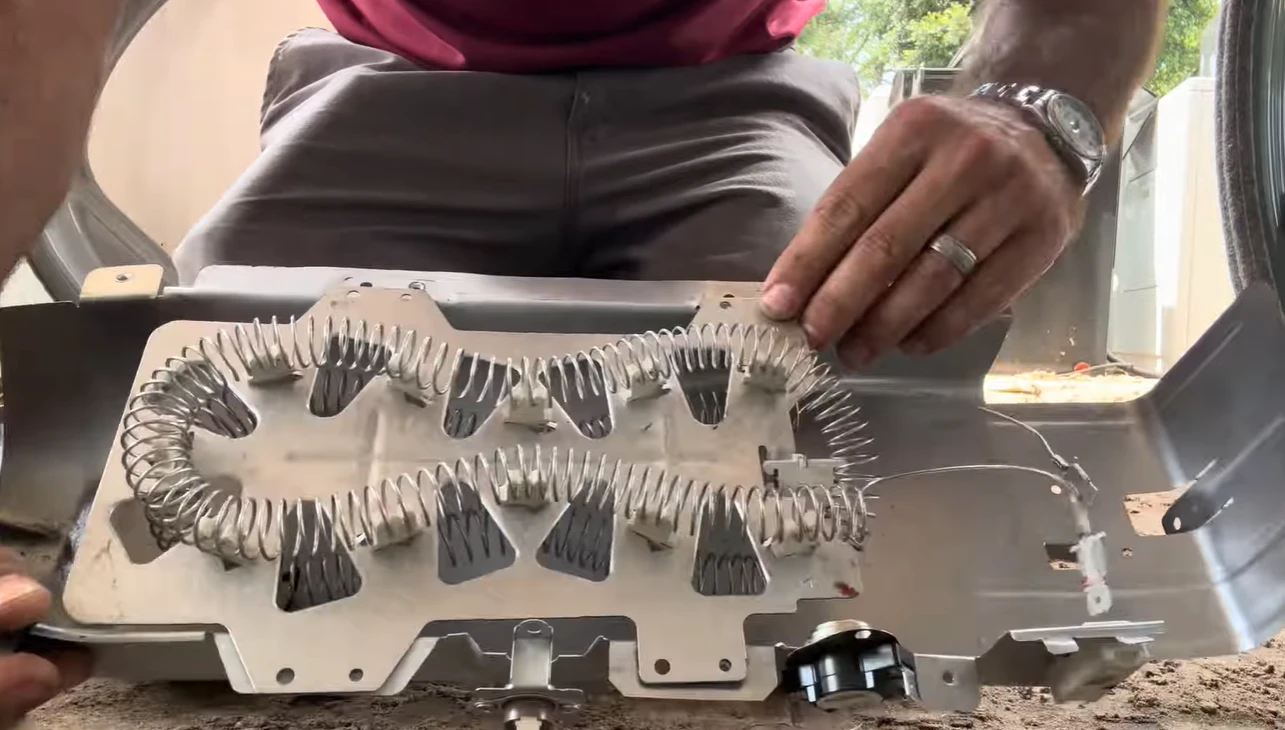
Test both for continuity with the dryer unplugged. A blown thermal fuse shows no continuity and often follows a blocked vent. A burned-out element also shows none. If both test fine, the thermostats or the controls are next. A meter test is the only sure way.
What does a high-limit thermostat do?
It opens when the dryer gets too hot, cutting the heat until the temperature drops, then closes again. A failed one can leave the dryer without heat or let it overheat. It is a safety part, so it is replaced, never bypassed, and a vent check goes with it. See the thermal fuse and thermostat guide.
What resistance should a good heating element show?
It varies by model, so check the manual or the part’s rating. As a rule a good element shows a low, steady resistance, often somewhere around 8 to 50 ohms, while a broken one reads open or infinite. Always test with the dryer unplugged and the element’s wires disconnected.
Why does my electric dryer only heat sometimes?
Intermittent heat often means a thermostat or thermal fuse opening and closing, a loose wire connection at the element, or restricted airflow tripping the high-limit thermostat. Check the vent first, then have the heat circuit tested with a meter.
Can low voltage make an electric dryer dry slowly?
Yes. If one leg of the 240-volt supply is weak or missing, such as with a half-tripped breaker or a loose terminal, the drum still turns but the element heats poorly or not at all, and clothes stay damp. A loose terminal block connection is a common culprit.
Can a bad heating element damage the dryer?
A failed element usually just stops the heat. But a shorted or partly broken one can touch the housing, trip the breaker or damage nearby wires. If the breaker trips when heat turns on, stop using the dryer. See the heating element guide for signs and costs.
Starting and controls
Why does my electric dryer hum but not turn?
The motor is trying to turn but something is stopping it: a seized drum roller or idler pulley, a failing motor, or a jammed drum. Turn the dryer off and unplug it rather than keep trying, because a humming motor can overheat if it stays energized.
Why does my electric dryer not start at all?
Check the breaker, with both halves on, then the door latch and the control lock. After that the usual causes are a door switch, a start switch, a blown thermal fuse on models where the start circuit runs through it, or a failed motor. See dryer won’t start.
What does the terminal block do?
The terminal block is where the power cord connects to the dryer. A loose or burned connection there can cause no heat, intermittent power or a burning smell. The part is inexpensive, but it sits on the 240-volt supply, so a technician should inspect it.
Can a control board make an electric dryer stop mid-cycle?
Yes, though it is less common than a thermostat, door switch or vent problem. A failing board can end cycles early, ignore buttons or run without heat. A technician rules out the cheaper causes first, because a board is among the costliest parts.
Why does my electric dryer stop and then restart?
Stopping and restarting after a rest suggests overheating: a restricted vent trips the high-limit thermostat, then it resets as the dryer cools. Clear the vent first. A door switch that makes poor contact can also stop the dryer when the door shifts.
Electrical safety
Can an electric dryer cause a house fire?
Yes. The leading cause of dryer fires is failure to clean, with lint igniting, and electrical faults such as damaged cords, loose connections and overheating parts also play a part. Clean the lint screen every load, keep the vent clear and stop using the dryer if it smells hot.
What should I do if my dryer cord is frayed or damaged?
Stop using the dryer and unplug it if you can do so safely. A damaged cord can overheat or shock. Replace it with one of the correct type for your outlet, and if the outlet is also scorched, have an electrician inspect it.
Should I unplug my dryer before checking it?
Yes. Unplug it or switch off its breaker before opening any panel, because the dryer carries 240 volts even when it is not running. Use a meter to confirm the power is off before touching any wiring, or leave the job to a technician.
Is it safe to run an electric dryer overnight or when I am out?
Many fire safety guides advise against it, because a lint or heat problem can start a fire with nobody there to notice. Run the dryer when you can check on it, keep the vent clear and make sure the smoke alarms near the laundry area work.
Repair and cost
How much does electric dryer repair cost in Plano?
Most electric dryer repairs in the Plano area cost about $150 to $400, parts and labor included. A heating element is typically $200 to $350, a thermal fuse or thermostat $150 to $275, and a cleared vent about $100 to $200. These are estimates, not a quote, so ask for the exact price in writing.
Is it worth repairing an older electric dryer?
Usually, if it is under about 10 to 12 years old and the repair is a small part such as a fuse, switch or element. If the repair nears half the price of a comparable new dryer, or the drum is rusted, replacing may be smarter. See the repair or replace guide.
What should an electrician fix, and what should a dryer technician fix?
An electrician works on the house wiring: the outlet, the breaker, the circuit and the wire size. A dryer technician repairs the dryer itself: the element, fuses, thermostats, switches, motor and controls. If the breaker keeps tripping, either can find the fault, but the outlet and circuit belong to the electrician.
Sources
- Your dryer’s installation and service manual, which governs over any general guidance on this page
- Plano Dryer Pros estimates of typical local repair pricing, checked against national consumer cost guides for context. See our Editorial Policy.
Get your dryer working again
Call and a person will answer, or request a repair online. You get the full price in writing before any work starts.